
L.M. Lyon, Market Gardener: Horse Radish

Sometimes an empty bottle is simply a container void of its contents. However, there are exceptions. And in this case the inscription on the bottle’s side: “Pure Horse Radish*, From L.M. Lyon, Market Gardener, East Saginaw, Michigan” provides a link to numerous Saginaw stories.
Lucius M. Lyon, was born in New York. He moved to the Saginaw area by 1870. Initially, after his arrival, he worked in the lumber and salt industry. The 1870 census notes he was a hoop maker, and the 1872 directory notes he worked in the salt industry. However, by the mid-1870s his occupation was listed as a market gardener.
Lyon settled in what is today the southeast portion of the city of Saginaw. At the time Lyon arrived, the area was a village, separate from adjoining East Saginaw, known as South Saginaw. Although the site was farmed in the 1840s and 50s, it had been transformed into a settlement centered on the lumber and the salt industries.

“During the early years of its existence, this busy progressive town had been known as Salina, but in 1866 it was incorporated as a village under the name of South Saginaw.”** In 1873, South Saginaw became part of East Saginaw.
Although the town in which Lyon lived was a thriving lumber center, he was able to carve out space to develop a market garden. Plat maps and the 1877 atlas indicate there was ample space for Lyon to raise crops. There are tantalizing clues to what he raised and the scale of his operations:
“There was a time when sauerkraut was relished by Germans and abhorred by all others, but the food has since become appreciated and is in general use. L.M. Lyon has put up 350 barrels of it this fall. As it takes an average of 75 head of cabbage a barrel, a total of 15,250 was consumed. ” The Saginaw Weekly Courier, November 8, 1882 as republished in The Saginaw News, November 12, 1950.
A Novelty Condiment
And, of course, the bottle documents Lyon’s efforts in raising horseradish. While L.M. Lyon is not mentioned, a news article provides a window into the novelty of the condiment in the Saginaw Valley in 1887:
“To the average agriculturalist the announcement that a horseradish farm would be a profitable investment would seem ridiculous, but recent experiment at Jackson, where a farm of that description has been established just outside the city limits will be something of a surprise, and a brief description of the same might be of interest.” After noting the grower’s development of his crop and how he marketed his crop door to door, the article continues, “The field today looks quite like a tobacco crop - leaves large- rank and healthy looking. The horseradish is planted like potatoes – in rows – small roots serving as seed and when harvested in the fall, the roots average nearly two feet in length and two inches in diameter.” The Saginaw Evening News, September 5, 1887.

Besides raising cabbage and horseradish, there is no record of the vegetables grown by Lyon. We know the family’s home was on East Street; however, the size of his garden and how he canned and marketed his products remains to be discovered.
Beyond operating their business, both Lucius M. Lyon and his wife Lucinda were engaged in their community – especially the Hess Street Methodist Church which, with the completion of a new building at South Washington and Randolf in 1890 was renamed Epworth Methodist. They had five children. In 1890 the paper announced the Lyons left Saginaw.
Going West
“L.M. Lyon, the well-known gardener, who recently left for Washington, writes that he arrived there all right, and will probably start a market garden in the far west under the supervision of his two sons.” The Evening News, October 14, 1890.
The following fall, the paper reported on his passing:
“A telegram was received here from Fairhaven, Wash., yesterday afternoon announcing the death by typhoid fever of L.M. Lyon. Mr. Lyon went west from Saginaw about a year ago and was formerly a member and a trustee of the Epworth M.E. church. He was about 65 years of age and leaves a widow and three children. The remains will be brought here for interment.” The Evening News, September 24, 1891. Although it appears he was interred in Washington State, a memorial service was held at Epworth M.E. church.
Mr. and Mrs. Lyon’s son, William K., continued living in Saginaw on East Street for over another decade. When Lucina passed away her funeral was held in the home.
The Next Generation
In 1902, William K. Lyon listed the family home for sale, the advertisement describes a two acre parcel with a ten room house, fruit trees and other things needed to run a market garden. Its advertisement notes the property is a “three minutes’ walk from car lines.” The following year an accounting of William's going-away party noted:
“Mr. Lyon’s parents were among the pioneer settlers of Saginaw and the family made this city its home until a few years ago when various members began to drift west and settle. Mr. Lyon is the last one to go and their friends, while regretting their departure, cordially wish them success in their new home.” The Saginaw Evening News, December 8, 1904.
A few years later, the paper reported William K. Lyon’s move to Billingham, Washington: “Mr. Lyon is continuing his former avocation of market gardening and has a fine market there for his products, which return him more than forty per cent of what he received in Saginaw.” The Saginaw Evening News, January 1, 1906.
* Well into the twentieth century horseradish is often spelled as two words.
** James C. Mills. History of Saginaw County Michigan. Saginaw: Seeman & Peters, 1918.
The Recipe: Horseradish Sauce

We toyed with the idea of simply grating horse radish and adding vinegar – probably what L.M. Lyon originally sold from this bottle. However, we discovered a recipe for a horseradish sauce:
Ingredients and method:
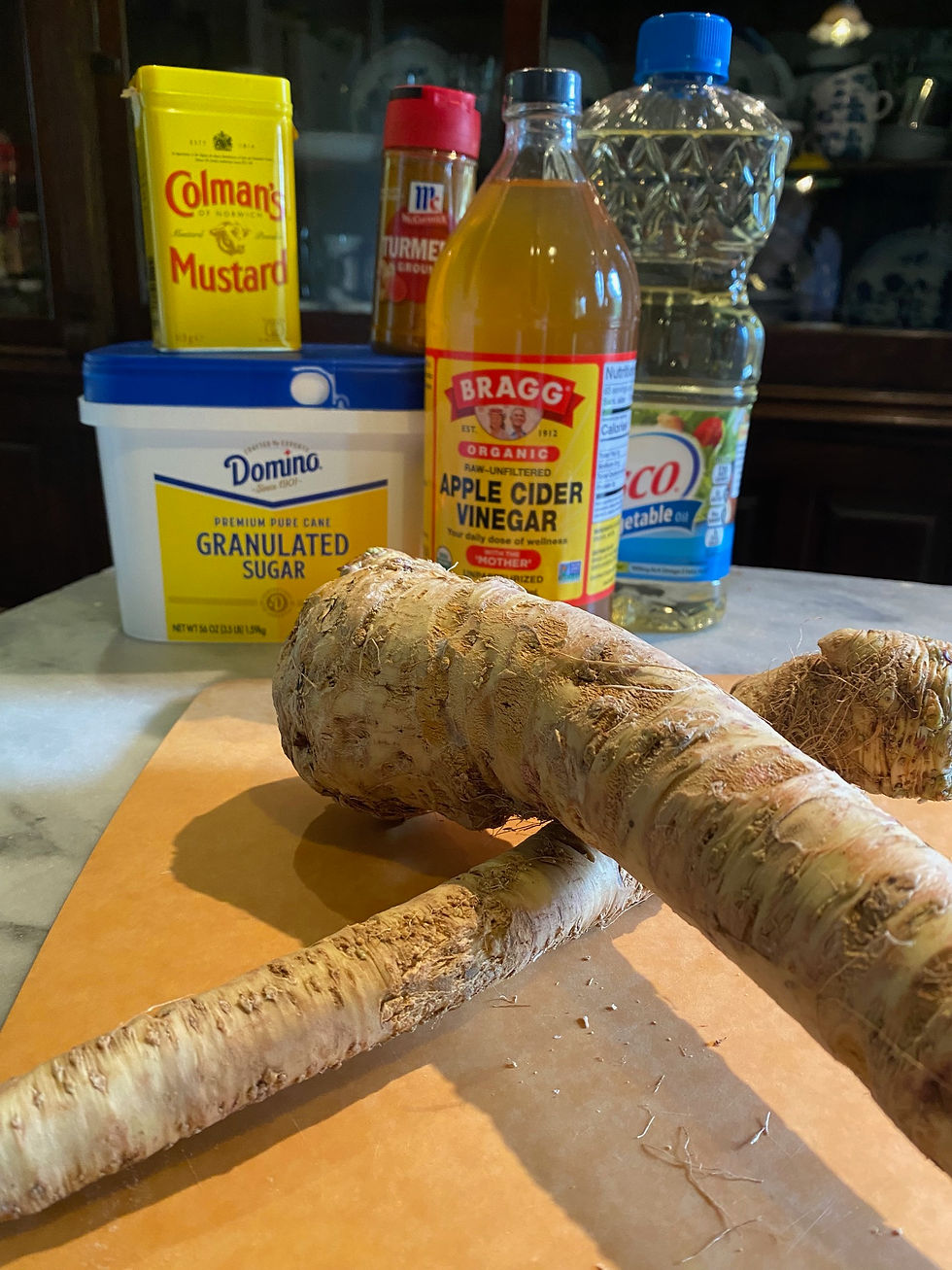
“Beat together one cup grated horseradish, one tablespoon each mustard, sugar, turmeric, four tablespoons vinegar and four of salad oil or melted butter.” The Saginaw Evening News, June 4, 1898.
Additional Note with a regret: When the CTK staff checked his serving pieces, he discovered a tragic oversight. Although we have specialized serving pieces for several esoteric purposes, he lacks a horseradish scoop.

CTK NOTES:
As we grated horseradish, the staff member was reminded of the description of his grandmother’s yearly horseradish preparation efforts with a neighbor. According to the story, each year they would start grating horseradish in the kitchen, move to the kitchen porch and end operations in the yard -simultaneously crying and laughing.
We also note, this is horseradish harvest season – emphasized in this recipe:
“This is made best in September or October, as horse-radish is best then, and it is a nice relish for meat.” From a recipe for Horse-Radish Vinegar, The Saginaw Evening News, April 20, 1882.
Final Thoughts
After taking a few minutes to clear your after grating horseradish, check out Horseradish History and this Ultimate Horseradish Guide for history, cultivation, recipe and tips.
If you are aching for more local horseradish history, check out 'As You Like It:' Frankfurts [Hot Dogs] Made in Saginaw.


