Joseph Goddeyne, Architect of the Original St. Thomas Aquinas Church
“Joseph C. Goddeyne, Bay City architect, recently completed plans for the building, designed in the old Spanish mission style. When the future St. Thomas Aquinas parish sister’s convent, and school are built, they will be of the same architecture.”
-The Saginaw News, August 29, 1953.
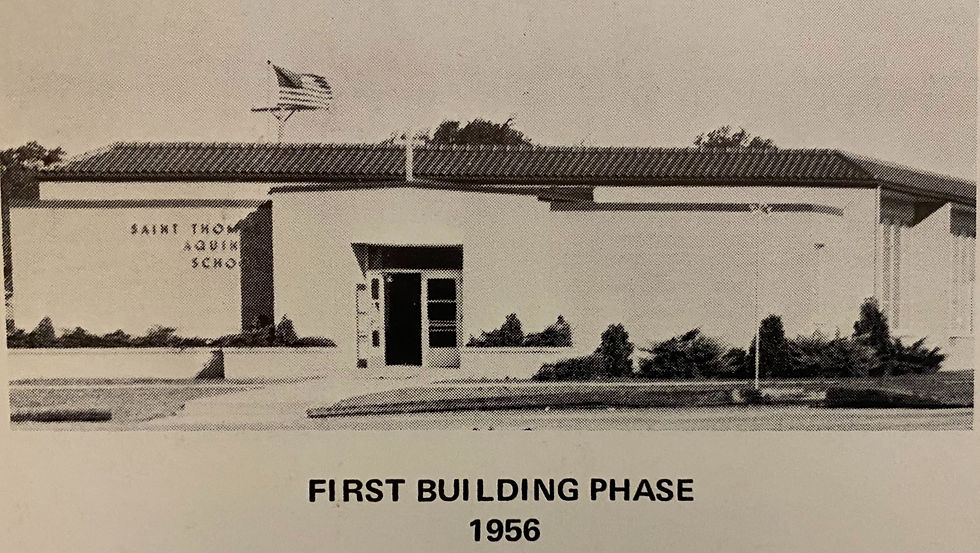

If you are familiar with Bay City landmarks – and we hope you are—the Bay County Building on Center Avenue is a spectacular and memorable example of the Art Deco Style. Completed in 1934, the structure’s elegant massing and finely detailed exterior and interior are the work of Bay City architect Joseph Goddeyne, the same architect who designed the first buildings of the St. Thomas Aquinas parish complex. While the styles employed by Goddeyne in the two projects could not be more different, careful examination of the designs shows a shared emphasis on thoughtful composition, detailing and skillful use of ornamentation.
Goddeyne’s archives are preserved at the Clarke Library at Central Michigan University. The finding aid for the collection provides a concise biography:
“Goddeyne, Joseph C. (May 8, 1889-June 24, 1964), a Bay City native, was a prominent Bay City architect whose plans frequently called for concrete construction. He earned a B.A. from the University of Notre Dame and a degree in architectural design from the University of Michigan.
Among his projects were numerous Catholic churches, schools, convents, including St. Paul’s Seminary in Saginaw, and county buildings in the Bay City area. Other buildings he designed include: St. Hyacinth Church and rectory, the James Clement Airport Administration Building, Holy Trinity Church, the Rachel Sovereign Memorial Home, and his own avant-garde, white and glass block home at 2275 Carrol Road. He created the drawings for the Alpena General Hospital, Rogers City Hospital, the Iosco County Courthouse, the Chippewa Memorial Hospital in Sault Ste. Marie, and Hubbard Memorial Hospital in Bad Axe, Michigan.
Two of his buildings of note are the Bay County Building and the Jesse H. and Anna Mulvane Besser House. The Bay County Building, located at 515 Center Avenue, on the corner of Center and Madison avenues, in Bay City, was built from 1931 to 1934 as a county-funded project to relieve local unemployment problems during the Great Depression. It is an 8-story Art Deco building. Goddeyne is credited with the building’s visually arresting exterior facade, unique to Bay City. This building is listed on the National Register of Historic Places. The Jesse H. and Anna Mulvane Besser House, located at 232 1st Avenue in Alpena, was built from 1938 to 1939 in a very modern style with the most modern and efficient equipment installed for Alpena’s leading industrial pioneers. (For further information on these buildings see: Buildings of Michigan by Kathryn B. Eckert, 1993, pages 329 and 449-450.)” (https://findingaids.lib.umich.edu/catalog/ehll--goddeyne)
The Clarke Library finding aid hints that Goddeyne’s work in Saginaw was not limited to the initial buildings at St. Thomas Aquinas. So far, we have identified several Saginaw Catholic churches he designed and are certain there are additional Saginaw projects and worship spaces for other denominations. [The names on the list below are the parish names at the time of construction.]
St. Helen’s Catholic Church, 2400 Block N. Charles, Initial Parish Building, Project announced 1950.
St. Josaphat’s Church, 469 Shattuck Road, Cornerstone laid 1952.
Holy Rosary Church, Dedicated 1953 – Demolished.
Queen of Angel’s Retreat House, 3400 S. Washington, Ground Breaking, 1954.
St. Paul’s Seminary, 2555 Wienke Road, Dedicated 1961 [Now Nouvel Central Catholic High School].
St. Helen’s Church, 2415 N. Charles, Dedicated 1963.
After preparing this week’s recipe—which requires an overnight rest—we encourage you to go out into the community and look at Joseph C. Goddeyne’s Saginaw buildings. Also, we encourage you to continue searching for additional buildings designed by this talented architect. If you make additional discoveries, please contact Tom Trombley at ttrombley@castlemuseum.org or call 989-752-2861 ext. 304.
The Recipe: Carol Ryan’s Roquefort Cheese Stuffed Lettuce


1 Large Head Lettuce
2 3-oz pkgs, cream cheese, crumbled
2 T. Milk
¼ tsp dry mustard
1/16 tsp. cayenne
Dash of salt
Wash lettuce, remove large outside leaves. (Save to use on individual plates.) Drain and remove the center core. Mix remaining ingredients together until smooth. Pack in the center of lettuce where core was. Wrap in aluminum foil. Chill overnight. When ready to serve, place loose lettuce leaves on individual salad plates. Cut head of lettuce lengthwise to form circles-place one on each salad plate and top with your favorite French dressing.*
Carol Ryan** From Friar’s Feast, published by St. Thomas Aquinas Parish
CTK Notes:
We are writing this prior to cutting our stuffed head of lettuce into circles, and will do so with great trepidation. We found similar recipes online and noted that they cut the lettuce into wedges – less dramatic but much less stressful.
The filling is good; however, the predominant flavor is cream cheese. We will add more Roquefort the next time we make it.
*Although we believe this recipe dates from the 1970s – after commercial French dressing had been standardized as the now-ubiquitous reddish dressing, we used a homemade pre-1950 version of French Dressing – a simple vinaigrette. This link will take you to a history of French dressing and recipe for French Dressing.

**We believe this is the same Carol Ryan, as she was extremely active in the Catholic church. While she appears to have lived out most of her life in East Tawas, a blurb about her death in The Saginaw News, again, suggests a connection to the area. We've included her obituary from the Bay City Times here for your own conclusions: