
Facts and Myths: Tales of the Bancroft House
“In 1865 George Cobb, chef at the Bancroft Hotel, originated the now nationally famous Bancroft corned beef hash. This delicious dish is listed on the menus of leading hotels in this country and in Europe. Whenever you order Bancroft corned beef hash you can be sure of a treat. Especially here at the Hotel Bancroft where the chef uses the same recipe developd in 1865.”
-From a mid-twentieth-century table display card used in the Bancroft Hotel’s restaurants.

Although it has been nearly 50 years since the Bancroft served as a hotel, for over 120 years it was the most famous hotel in Saginaw. Its opening in 1859 helped put the city of East Saginaw on the map, and it developed a nationally recognized reputation. The Bancroft’s run as a hostelry was legendary. And like all legends - and corned beef hash recipes - the stories just kept growing and getting a little better.
Time for a quick game of Bancroft trivia–stories that don’t include corned beef:
Which of these stories are true:
At the dedication of the Bancroft House on September 7, 1859, lumberman Curtis Emerson, furious at not being invited to the celebration, walked up and down tables where elegantly clad guests were dining. The next day he sent money to pay for the damage.
During Saginaw’s great oil boom of the 1920s, an oil well was drilled in the parking area behind the hotel. For several years, the natural gas from this well was piped into the hotel, where it was used for cooking and heating.
The Bancroft is named after historian and politician George Bancroft.
Architects for the 1915\16 building had worked in Frank Lloyd Wright’s office.
The answers:
Although Curtis Emerson’s alleged misbehavior was reenacted in 1959 by a Mackinac-clad pseudo-Curtis Emerson for a celebration of the Saginaw News’ anniversary - both the News and hotel were founded in 1859 - there is every indication this story was invented. Records show Emerson was part of the committee planning the dedication. There is no mention of this event until the 1950s; furthermore, Emerson was known as a fastidious dresser and would never have worn the clothing of a lumberjack – that said, he probably could outdrink any shanty boy.
Bancroft No. 1 was a real–and a long productive–oil well. Concerns about fire danger and declining production resulted in it being capped in 1946,
The first toast at the Bancroft House dedication, held on September 7, 1859, was to “George Bancroft – a polished scholar, an able historian, a high-minded patriotic citizen, and God-father of this house.” For more about George Bancroft.
When the 1859 Bancroft House was replaced by the Hotel Bancroft, the architect for the 1915\16 building was the Chicago firm of Schmidt, Garden and Martin. Two of the principals of the firm had worked in Frank Lloyd Wright’s office. (Scans of the original architectural drawings for the 1916 Hotel Bancroft building are available online through the Art Institute of Chicago.)
And this brings us back to the story of Bancroft Hash…
If you haven’t been following our exploration of the myth of Bancroft House Hash, we encourage you to take a few minutes to revisit our past posts.
Based on our research, this is how we intended to conclude our exploration:
The story of Bancroft House Hash:

The story of the invention of Bancroft House Hash and to whom to credit it remains shrouded in conflicting accounts. If the recipe was actually perfected in East Saginaw at the Bancroft Hotel, it happened after 1876. Contrary to the mid-twentieth-century display cards–the most scholarly of all sources–George Cobb could not have created the recipe in [East] Saginaw in 1865. He didn’t arrive in East Saginaw until about 1876.
By 1893, a distinctive recipe for corned beef hash–diced boiled potatoes and corned beef with more than a splash of heavy cream–appears to have been named after the Bancroft House in Saginaw. Assuming all recipes called Bancroft House Hash or Bancroft Hash are named after the Bancroft House in Saginaw, Bancroft Hash was a regionally and nationally recognized variation of classic corned beef hash. It is harder to document that it was featured on hotel menus all over the country. Although there are secondary mentions* of Saginaw residents seeing it listed on hotel menus, we are still searching for an actual menu documenting it.
While the basic ingredients never really vary–with the exception of the inclusion of nutmeg** and parsley, the proportions, fineness of chopping and the cooking techniques vary widely. It is the addition of cream that separates Bancroft Hash from traditional corned beef hash. In some preparations, the cream is barely detectable and in others, the corned beef and potatoes almost float in a sea of cream.
We were ready to credit George Cobb as the inventor–it is hard to conceive of Farnham Lyon, the proprietor of a thriving hotel, experimenting with cream and corned beef–and then, after we had used all of our corned beef, we found this:

“It is not easy to say whether Lyon made the Bancroft or the Bancroft made Lyon. Certainly the major had, when he arrived in Saginaw [about 1876], the makings of a national reputation. Because of that, the fame of the Bancroft spread all over the county; it became known for its hospitality, the comfort of its accommodations, the general excellence of its cuisine. Bancroft corned beef hash, conceived during the Lyon regime, still lives under that name in hotels east and west. The recipe was from one used by the proprietor’s mother. Bancroft maple syrup, too, lingered long in the memory of guests.” (Seventy-Five Years of Service: Hotel Bancroft, Saginaw, Michigan.)
The Recipe–The One with the Nutmeg
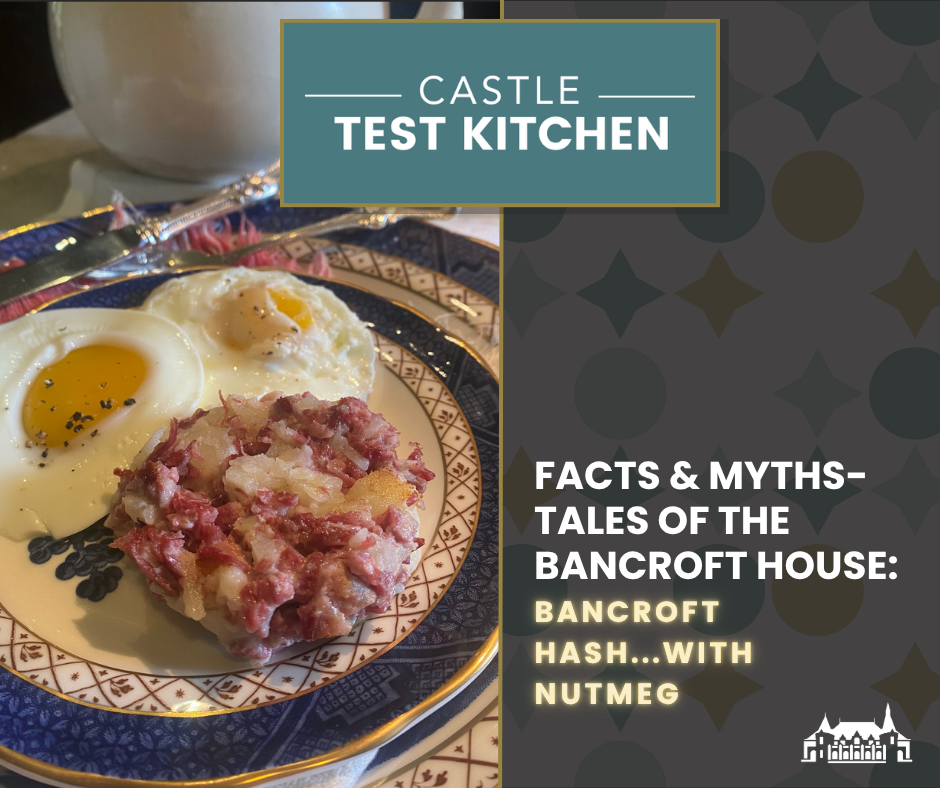

In the cookbook Savoring Saginaw, the authors, Jean Beach and Pat Shek, provide two recipes and note they are both “genuine” recipes for Bancroft Hash.
This is one of the two “genuine” recipes:
4 c diced, cooked corned beef
4 c diced cold, boiled potatoes
1 c. coffee cream
Pinch nutmeg
Heat in a double boiler. Mold in patties. Place in a frying pan and brown in butter both sides.
CTK NOTES:
Although not particularly photogenic, and we really couldn’t form attractive patties, the results were quite palatable–and we suspect the candidate most likely to have been featured in the Bancroft’s Coffee Shop in the 1950s.

We wonder if the Hotel Bancroft’s institutional history was weak and the recipe varied over time.
We are out of corned beef and potatoes, and tired of chopping; however, if you have another variant of Bancroft House Hash, we will happily try it–as long it doesn’t require us to make our own corned beef. This is Farnham Lyon’s recipe from The Saginaw Cook Book:
“Get the plates of beef or small ribs. For 1 bbl. [barrel] of 40 gallons, use 25 lbs. of salt and 4 lbs. saltpetre dissolved in hot water. When cool, put over the beef to cover. “
*One of the Bancroft Hash sightings:
“The Bancroft is noted for its hash.
Robert Grant Sr., president of the hotel corporation, recently returned from a trip to Port Antonio, Jamaica, West Indies, and he found evidence there of the local eatery’s fame.
The Saginawian stayed at the Tichfield Hotel at Port Antonio and found featured on the menu, ‘Famous Bancroft Hash” (The Saginaw News, March 11, 1948.)
**Some sources list nutmeats. It is our opinion that the inclusion of a mystery nutmeat is caused by a mistake in transcription and it should have been nutmeg.


