
The Montague Cottage: From Saginaw to Lakeside-Edwina Montague’s Nut and Fig Paste
“Higgins lake beyond Roscommon, a pretty inland lake, is the summer home of many Saginawians. The lake is divided into camps, Lakeside and Cottage Grove. At the former are cottages owned by M.N. Brady, E.D. Church, Dr. J.N. Kemp, R.S. Montague, George L. Burrows, Jr., Mrs. Grace Britton, C.E. Powell and Frederick Carlisle. At Cottage Grove are those owned by Mrs. Flora B. Vincent, Newell Barnard, James G. Macpherson, Mrs. Violet B. Brand, Gilbert M. Stark, Roger R. Hill, George H. Boyd, Willis T. Knowlton and Mrs. George Grant, Jr.”
-The Saginaw News Courier, June 11, 1922
(This newspaper article overlooks a third “Saginaw” camp – Pine Wood.)
This post is related to last week’s post.
Although today, Robert S. and Edwina Burrows Montague’s home on South Washington Avenue is a Bed and Breakfast, their summer home in Lakeside Association at Higgins Lake continues to be owned by their descendants. Libby Mundy, their Granddaughter, graciously shared this history of her family’s cottage. She wrote it to celebrate the centennial of its construction:
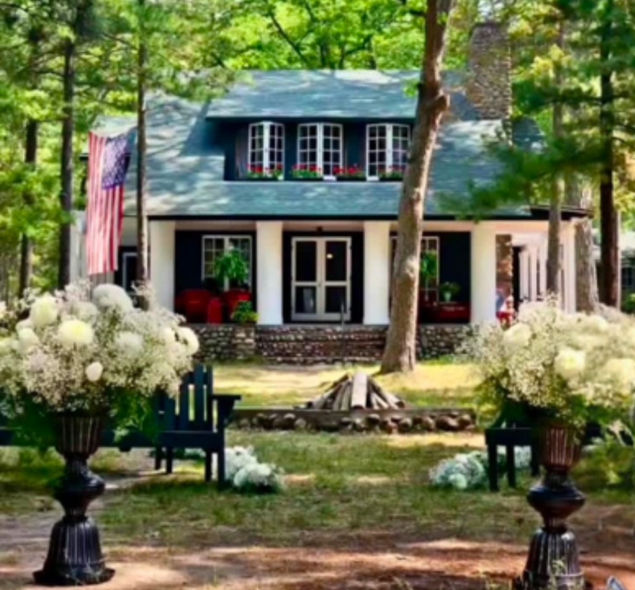
1922-2022 - Centennial
Issac Shirey [the contractor] constructed one of the finest cottages to be found on the shores of Higgins Lake, the summer of 1922 (construction lasted from May-August) belonging to Mrs. Edwina (daughter of George and Julia Burrows) and Robert S. Montague of Saginaw, at Lakeside Camp. The Montagues had two children, Mary Sage (Pletscher) and Robert S. Montague, Jr. The Montagues hosted their first guests at the cottage August 12, with all guests signing the guest book with quotes of their fond memories.
The cottage was modeled after a Southern country house and became the center of social activity for the camp. For many years an annual Saturday night picnic brought the entire camp to the Montague cottage and beach front. Robert S. Montague, Jr. started his own business called SBS (Sugar Beet Soap) Products, Inc. He developed a way to use sugar beet by-products to make hand creams and soap. After his death in 1951, the business was sold to the Andrew Jergens Company of Cincinnati.
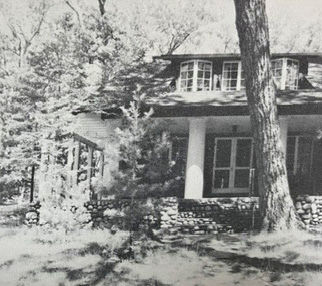
The grand cottage, which is a two-story structure with a 52’ x 76’ footprint, is of frame construction, built of cypress exterior cladding with interior walls of southern pine and beadboard. A spacious wraparound front porch with custom red Italian tiles, supported by four large white pillars in the front give the cottage a dramatic and stately appearance from the front path and lake. The cottage includes three beautiful cobblestone fireplaces, the work of a local mason, Ora Billman.
The cottage is comprised of four bedrooms on the first floor, plus formal dining, kitchen in the rear of the cottage, screened in veranda on the back and a front living room. There are two full bathrooms-one located in the middle of the first floor and the other upstairs. All bedrooms are adorned with a sink for personal hygiene. The master suite is stunning and graces the front of the second floor (the entire width) with one of the three fireplaces and south facing windows overlooking the lake. A butler’s bell next to the bed was something the grandkids always liked to play with and show off. Two additional bedrooms and a dormer for the kids completes the second floor of the cottage.
A detached two car garage stores the summer toys and a ping pong table. The chauffeur’s quarters (the apartment) is attached to the garage, heated by a wood stove, and included a sink and shower.
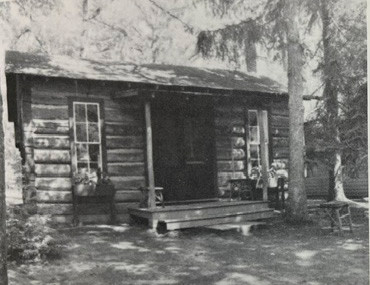
The log cabin has historic significance, built by Lorenzo Burrows (founder of the Lakeside Camp) and Chief Shoppenagon (of the Chippewa tribe). The cabin was built prior to 1880. The Lorenzo Burrows Cabin is considered to be the oldest original structure in camp and one of the oldest on the lake. Circa 1905, Edwina Burrows became owner of the log cabin, which she named Cloverly. Several rooms were added to the original structure but removed in 1922 when the cabin was moved to the back of Lot 17. Some sizable maintenance work was completed in 2018 with log replacement and chinking. Mona & Bill Pochelon were known to skip breakfast at the dining hall each morning and enjoy their traditional breakfast, coffee and morning prayers in the log cabin.
The only son, Robert S. Montague, Jr., would marry Mona Lillian Taggart from Pinewoods camp and have three children Robert S. Montague III, Sharon Montague (Taber) and Elizabeth Montague (Mundy). Robert and Mona would divorce in 1958 and the cottage would be left to the kids, with Mona (and her new husband Bill Pochelon) still using and managing the cottage until her passing in June 2000. Mary Sage was gifted the lot/parcel to the east which her children, Hank Pletscher and Debi Cox, now own.
The bluish-green paint with white trim embodies the era and essence of the abundant greenery, white pines, crystal clear lake and vibrant Michigan summer skies. The color combination can be seen at numerous other cottages among the three camps. Ella Louise Hannon (known to the family as Aunt Babe) ran a shop, called The Oxford, in the log cabin for years selling fine linens, dolls and other such items. The log cabin would be moved from its original location near the front path to its current location. A rear addition was added at that time which included a small kitchen, bedroom, and half bath. The cottage, cabin, and garage sleeps 21 guests comfortably.
The boat house offers additional storage and entertaining space; the second level was re-opened in recent years and offers more space to relax and take in lake views and the summer breeze.
The cottage continues to be owned and used by descendants of Robert S. and Edwina Burrows Montague, and reminds us of early descriptions of summering at Higgins Lake:
“The Pure air, clear water and cool nights at Higgins Lake are conducive to complete rest and there is freedom from care and absence of all responsibility that is refreshing. The life here needs never be monotonous, for when one is not inclined to sail, fish or bathe, there are no end of attractive walks and quiet shady corners, where one can read or rest. When night comes the camp fires are lighted in front of the cottages and there are corn roasts, marshmallow bakes or pop corn and watermelon parties. The lake is a constantly changing picture.” (The Saginaw Evening News, August 11, 1896.)
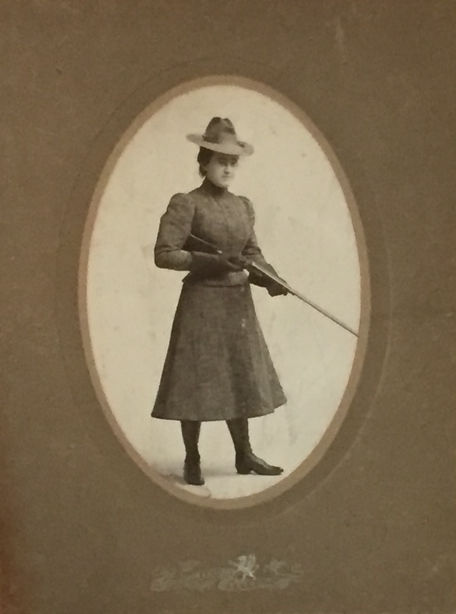
This week’s weather in Saginaw, reminds us that warm autumn days in Michigan have always been magical – and fleeting: “A number of Saginaw resorters are taking advantage of warm fall weather as they keep their cottages open at Lakeside.” (The Saginaw News, September 12, 1938). The Montague family was amongst the group taking advantage of warm fall weather.
Note: The architect for the Montagues’ cottage was the Saginaw Firm of Cowles and Mutscheller – for information about Cowles and Mutscheller: https://www.castlemuseum.org/post/finding-purpose-amidst-tragedy
The Recipe: Edwina Burrows Montague’s Nut and Fig Paste on Bread
Wash and remove end from 1- 2 pound of figs, chop fine and boil in very little water until tender, Spread peanut butter on buttered slices of bread, marmalade and fig paste. Back to Kitchen with Lakeside Cooks: [Saginaw, Michigan], Lakeside Association, [circa 1920]
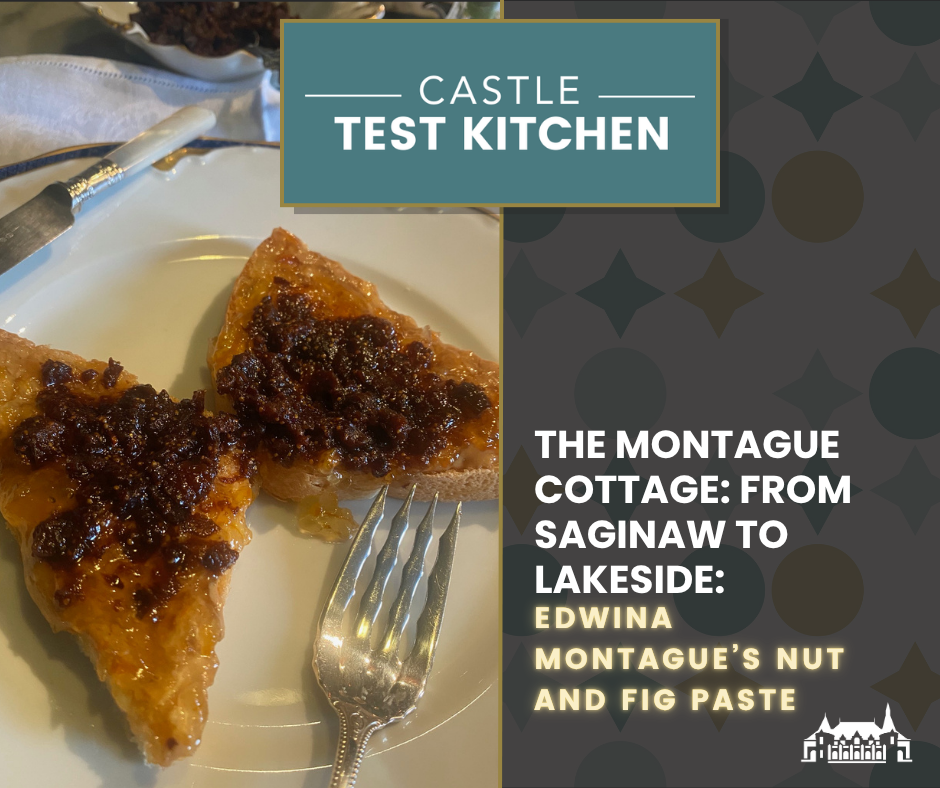
As expected, Edwina Burrows Montague contributed numerous recipes to Back to Kitchen with Lakeside Cooks. We were tempted by several of her contributions – especially Emergency Soup and her interpretation of that Saginaw favorite, Chopped Peanut Sandwiches. After much deliberation, we settled on this simple dish. Perfect for a warm late autumn breakfast. Or even better, make them as a picnic snack and go to Ojibway Island – where you can overlook Lake Linton to the Montague Inn and look at the Montague family’s other home.
CTK Approximation:
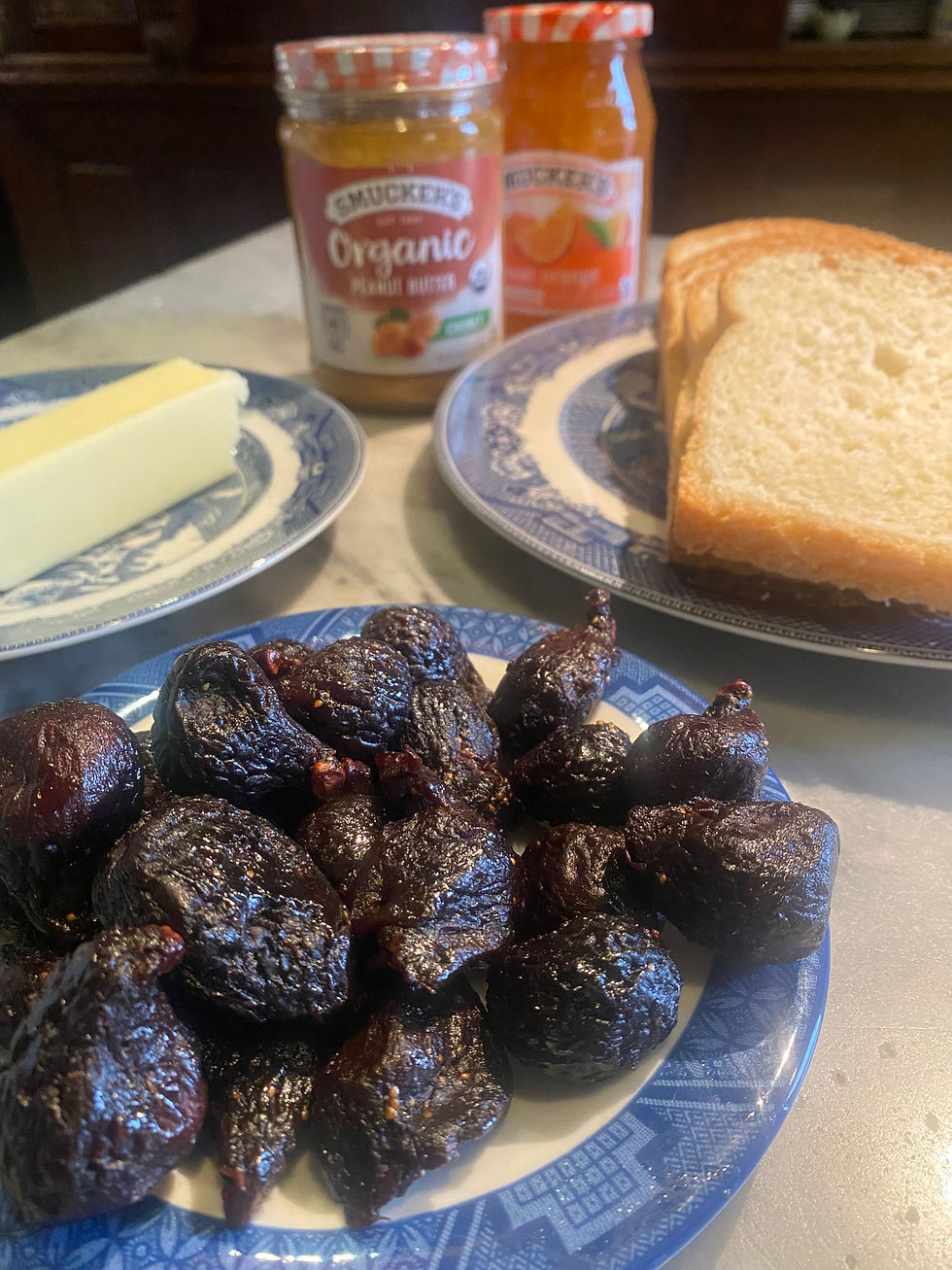
½ pound figs – Alas, we were unable to find fresh figs and substituted dried figs.
1 Jar of Orange Marmalade
1 Jar of Peanut Butter
1 Stick of salted butter
Spatz Bread
Preparation
Open package and chop finely. Place chopped figs in saucepan with water to cover and cook over medium heat until tender. As we were using dried figs, we added additional water while they were cooking.
Cool.
Assembly
For each serving:
On each slice of bread, spread In the following order: butter. peanut butter, orange marmalade. At this point, you have three layers of spreads on one slice of bread and you may need to add the fig paste as artful dollops.
CTK Notes:
While we apologize for our failure to secure fresh figs, our approximation made from dried figs was really quite wonderful.


