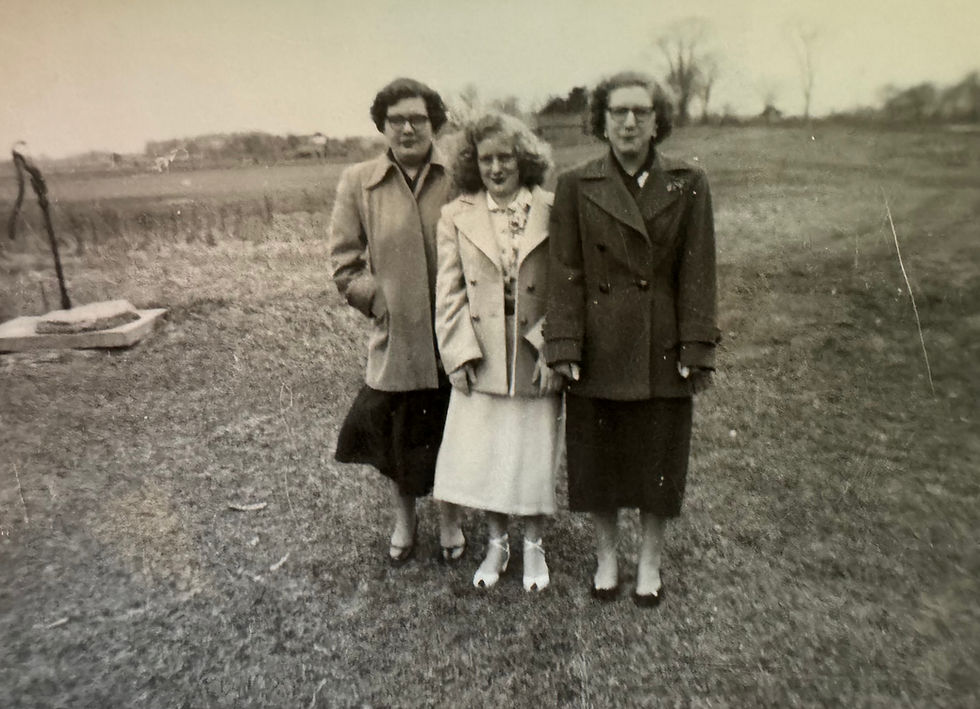
Eleanor Richardson Gage
- Mar 22
- 8 min read
Last year, we received a donation of archival material – an intriguing and enigmatic mixture of photographs and documents. As we studied and pondered, we realized this diverse collection opened a window into the life of Eleanor Richardson Gage, a woman of whose accomplishments–we are embarrassed to say–we were unaware.
For an eloquent summary of her life, we turn to an article published at the time of her passing:
“Long, Fruitful Life Ends for Eleanor Richardson Gage

Mrs. Eleanor Ricahrdson Gage of 515 Owen, mother of councilman William Glover Gage Jr. and widow of one of Saginaw’s most notable circuit court judges, the first William Glover Gage, died yesterday afternoon at St. Luke’s Hospital after a long illness. She was 71 years old.
Mrs. Gage was an extremely capable women who played a prominent role in city and school affairs in the 1920s. In later years she belittled her earlier activity, calling it “‘wind blowing over the waste.”
She felt her only real accomplishment was “being a wife and mother.”
Despite Mrs. Gage’s feelings in retrospect, her life cannot but be viewed as remarkable one.
Mrs. Gage organized the first Republican Women’s Club here in 1920, becoming its president. A little more than one month after group was formed, men members were admitted and the name was changed to Saginaw Republican Club. In January 1921, Mrs. Gage was chosen as chairman and keynote speaker for the Saginaw County Republican convention staged in February of that year.

The first woman to serve as vice-chairman of the Saginaw County Republican Committee, Mrs. Gage also was a member of the Republican State Central Committee. She was active in the Women’s suffrage movement here and had a hand in organizing the Saginaw League of Women Voters.
Mrs. Gage was militant in her advocacy of woman suffrage in the years of campaigning before the right of women to vote was written into the Michigan Constitution in 1917 and into the United State Constitution in 1920.
PTA work engrossed her for a number of years. She a was a pioneer in PTA activity. As recording secretary of the Michigan Parent-Teachers Association from 1921-25 she assisted in organizing the state association. In June 1922, she was elected president of the City Council of Parent-Teachers Association here but resigned that post in July, 1922 after being appointed a member of the East Side Board of Education.
Mrs. Gage was the first woman member of the school board. She resigned from the presidency of the PTA Council because she felt it was incompatible for her to head the council at a time when she was serving on the school board. She was elected to the school board in 1924 but resigned in 1926 because she disagreed violently with administrative and teaching policies. To back up her protests, Mrs. Gage though a Protestant, shifted her son, now Councilman Gage, from Saginaw High School to St. Mary’s High, a Roman Catholic school.
In January 1925, Mrs. Gage left Saginaw for Washington D.C., to become office director for the National Congress of Mothers and Parent-Teacher Associations. She served as assistant national secretary of the PTA Congress.
A writer as well as organizer, Mrs. Gage was editor of the PTA Bulletin in 1925-26 and was contributor to Atlantic Monthly, Harper’s Magazine, Arts & Decoration, and various other magazine and periodicals. She was an officer of the Saginaw Winter Club and active in the Saginaw Art Club and Saginaw Woman’s Club. She was a member of the Michigan Woman’s Press Association.
In other activities, Mrs. Gage served on the legal advisory board during World War I and was a member of the Saginaw Children’s Free Ward Association. Mrs. Gage also taught PTA summer courses at Central Michigan College in 1925-26.
She was a member of the Saginaw Humane Society, the Michigan Historical Society and the Children’s Free Ward Association.
Eleanor Richardson was Jan 10, 1881, at San Antonio Tex. She came to Saginaw in 1893 to live with an aunt, Mrs. A.H. Hunter, after the death of both of her parents.
She graduated from Saginaw High School in 1899 and attended Saginaw Business College. From 1900 to 1911, when she married Judge Gage, she was private secretary to George B. Morley, president of Second National Bank. Then followed her activity in politics and in civic and school affairs.
After Judge Gage’s death, Mrs. Gage became an antique dealer conducting the business at her home 1210 Thompson.*


From young womanhood, Mrs. Gage was an admirer of fine old furniture and for many years before her death she was one of Saginaw’s best known dealers in antiques. Dealers and individual buyers came to Saginaw from many miles around to consult Mrs. Gage on the authenticity of antiques they had for sale or considered buying. She was recognized state-wide as an authority on antiques.
When the new St. Luke’s Hospital was opened in April, 1953, Mrs. Gage became the first patient there. She was one of the early and ardent supporters of Woman’s Hospital, predecessor of St. Luke’s and served for many years as a member of the board of Woman’s Hospital Association, the Hospital’s governing body. Her interest continued when the hospital was taken over in 1932 by a Lutheran group and became St. Luke’s Hospital. Through the years her zeal never flagged and she took an active part in the campaign for funds for the new St. Luke’s Hospital.
Her many years of activity in hospital’s behalf drew her a reward when she was made an honorary life trustee at St. Luke’s Hospital. To the day of her death she continued as the hospital’s historian.
Mrs. Gage was an active member of First Congregational Church and its North End Circle.
She leaves two children, Councilman Gage and Mrs. E. T. O’Keefe, 515 Owen, the former Bird-Ellen Gage. (The Saginaw News, August 24, 1952.)

*She started as an antique dealer, while still living at 102 Fitzhugh Street – a home constructed in the 1850s for Jesse Hoyt’s Sister.

The Recipe: Chelsea Buns

Although unable to locate one of Eleanor Richardson Gage’s recipes, in tribute to her interest in history, antiques and the Gage family’s involvement in the local chapter of the Daughter of American Revolution, we are providing a recipe for a traditional American Dish --Chelsea Buns, a precursor to the sweet rolls of today.**

Ingredients:
The Dough
6 c. flour (unbleached all purpose)
3 eggs
½ c. butter, one stick (room temperature)
1 ¼ c. milk
2 packages of dry yeast
1 Tbsp. salt
1 Tbsp. sugar
The Filling
4 oz. currants (fresh or dried currants that have been plumped in warm water and drained)
4 oz. brown sugar mixed with 1 ½ oz. white sugar
4 oz. softened butter
2 Tsp. ground cinnamon (optional)
grated peel of 1 lemon (optional)
The Glaze
1 c. Sugar
½ c. Milk
Instructions:
Put your flour in a large mixing bowl. Work the butter into the flour thoroughly with your hands so that it is absorbed by the flour. In a separate bowl whip your eggs thoroughly.
To the eggs add the sugar, salt, milk (warm, not hot) and the dry yeast. Blend all of these ingredients well.


Pour egg mixture into the flour/butter and mix with a wooden spoon until it comes together. Knead it with your hands until it becomes similar to bread dough. If it is a little soft, add a little flour to stiffen it some and to keep it from sticking to the bowl.
Cover with a warm damp cloth and set it aside in a warm place to let it proof (rise) about an hour. In the meantime, have your currants, butter and sugar put into small bowls to have ready for the filling of the dough.


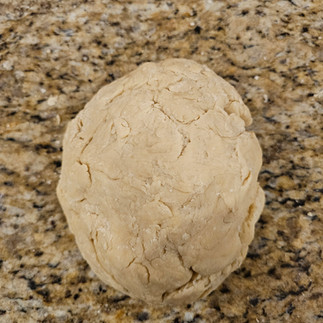


After the dough has risen you are ready to roll out the dough and put in the filling. Start by flouring your work surface so the dough doesn’t stick to it.
Gently punch the dough down to let out the air and work it into a ball. Roll it out into a rectangle approximately 18″ to 20″ inches by 12″ to 14″ inches and around a ½ inch thick. Lightly score the dough vertically to create three equal sections.


With a table knife, spread half of your softened butter on the left two sections leaving the right section uncovered. Evenly sprinkle half of the sugar over the butter and then half of the currants evenly over that. Add half of the cinnamon, if you choose to use it, over that.
Gently lift the right third of the dough and fold it over the center third and gently press it down. Now take those two and gently fold it over onto the left third and press down gently. You now have a rectangle one third the size you started with but three times as thick.
Lightly flour your work surface again and center your dough so that it looks like a rectangle again. Roll the dough out as you did before until it is as large as the rectangle size we started with. Now repeat the filling steps, but this time, spread the butter/sugar/currants/cinnamon and lemon peel (if you choose) over the whole surface. Once you’ve done that, start at the edge of the dough closest to you and proceed to roll the dough up into a pinwheel log, sealing the last half inch or so with a little water. The log should be around two inches in diameter.
Now take a medium sharp knife and proceed to cut the buns from one end of the “log” to the other at about an inch and a quarter to an inch and a half for each one. Lay them flat side down on a baking sheet no farther than an inch apart. As they rise in a warm place for about a half hour to forty-five minutes they should touch each other.

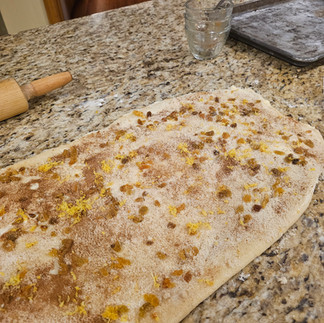


Bake them at about 375° for about 25 minutes or so (depending on the thickness of the buns). (We baked ours for about 19 minutes) Do not bake them too long, they are to be soft not firm and should be rather square in shape. They shouldn’t be dark brown but rather light in color.
For the glaze, add the milk to the sugar and gently heat it, stirring until you blend the two together. Lightly spoon the glaze over each bun. This glaze is not to be like an icing but rather a thin glaze to enhance to bun’s flavor. Cool and enjoy.


CTK Notes:
–Alas, we could not find currants, dried or otherwise, so we resorted to using golden raisins, which we plumped in warm water and then chopped slightly.
–We found this dough to be quite tough, compared to a modern sweet roll dough. It was much heavier with less stretch than we were used to. We tried our best, but for future attempts, we may stick to regular bleached all purpose flour, which has more moisture than the unbleached variety.
--CTK taste testers agreed that they preferred the texture of more modern recipes--but it didn't stop them from eating the Chelsea buns.
**We borrowed this recipe from Colonial Williamsburg, where they illustrate making the rolls in an outdoor wood-fired oven. The CTK wood-fired oven was being repaired this week, so we resorted to our standard convection oven–but you can view the video here.
Notes:
Although it does not appear that Eleanor Richardson Gage was a member of the DAR, her daughter, Bird Ellen Gage O’Keefe, and several of her in-laws were active in the local chapter.
This link will provide more information about the Gage Family: